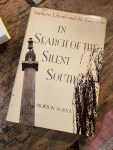
 Morton Sosna’s In Search of the Silent South doesn’t appear on any must-read lists about Southern history. Published in 1977, the year after Jimmy Carter’s election to the presidency, the book provides a historical examination of Southern liberals with specific attention paid to the issue of race, vis-á-vis segregation, integration, social equality, etc. Born in Chicago, Sosna earned a PhD at the University of Wisconsin, then worked at Stanford University and the NEH. (He died of cancer in 2011.) Other than this book, he did some writing and editing on subjects within the humanities and Southern history, such as a 1980 article titled “Protest at Selma” in The American Journal of Legal History.
I actually stumbled on this book in a local flea market. Of course, most flea-market bookshelves are loaded with paperback mysteries, subscription cookbooks, and short-lived pop culture topics, but it is also possible for an avid searcher to find some gems. This one appeared on a single shelf among some old furniture, and I surmised from the name inscribed inside several Southern history books shelved around it that it was from a single individual’s purged collection. Most of the titles were either widely available or ones I already had, but In Search of the Silent South was a book I had never heard of. So I snagged it.
Like any work in the history genre, this book took a while to read and digest. Knowing nothing about the book or the writer, I wondered from the subtitle “Southern Liberals and the Race Issue” whether this would be a post-Nixon conservative historian bashing left-wingers for their faulty arguments and their misguided policy ideas. That it was not. Morton Sosna provides a very fair and thoroughly supported argument that the group (movement?) as a whole cannot be distilled down to a few basic tenets: pro-worker, pro-black, anti-racist, etc. Here, Sosna wades into the socio-political complexities that have harried the fabled Southern liberal, beginning with the Louisiana writer George Washington Cable, whose public pronouncements against anti-black prejudice and discrimination in the late 1800s landed him a few supporters and a lot of detractors. However, Cable’s efforts created a “type” of Southerner who would spend the late nineteenth and the whole twentieth century swimming upstream against the weighty magnitude of their fellow Southerners’ support for segregation and inequality.
After leaving Cable’s era, a reader of Southern history will find many familiar names, from Dr. Will Alexander to Aubrey Williams, from Howard Odum to Virginia Durr, et al., et al., et al. Perhaps Sosna’s most important contribution to a better understanding of the mythology of the South is his picking-apart of the twentieth-century Southern liberals’ back-and-forth over how to dismantle Jim Crow, at what pace to dismantle Jim Crow, and to what extent their culture even should dismantle Jim Crow. Southern liberals were not a monolithic group. Here, we read about the extremely important social scientist Howard Odom, who had his own ideas about how meticulous study and commensurate action could improve the lives of the Southerners, and we also have the blue-blood newspaper editor Virginius Dabney, who supported improving equality while maintaining segregation. There were overlapping groups and coalitions and organizations and committees that struggled to endorse a solidified position on anything, because they bickered over the dueling issues of obvious inequality heaped on black Southerners, a white population of Southerners who resisted change, the external and internal pressures of communist organizing and rhetoric, the competition for influence against Northern liberals, and the differences of opinion over the role of the federal government, as well as the omnipresent tensions over the varied opinions that any group has contains. The Interracial Commission had to grapple with these things, as did the Southern Regional Council. Ultimately, though, Sosna shows us that the often-stifled work of Southern liberals eventually came to a head in 1950, when post-New Deal, post-World War II, Truman-era Democrats had to face facts: segregation and its attendant inequalities must be opposed unequivocally. As evidence of this eventually adopted hard-line approach, the last chapter features a discussion of writer Lillian Smith.
At the time of its publication, In Search of the Silent South got some nice reviews. A December 1977 review in the Richmond Times-Dispatch called it a “valuable study” that resisted the urge to take sides and declared that it “illuminated another aspect” of historian C. Vann Woodward’s work. That same month, a professor from Salem College assessed in the The Sentinel newspaper that “Sosna clearly recognizes the liberals’ contribution in their deep conviction that the South would come to a just and viable solution to racial issues.” In a somewhat strange choice of wording, the community college professor who reviewed it for the Tampa Tribune remarked that, in a world where some books are like “cotton candy,” this one is like “beef jerky that must be chewed, chewed, chewed.” Finally, a thoroughly argued Knight-Ridder review that ran in several newspapers around the country said it was a “thoughtful and provocative book [that] takes a scholarly plunge into relative uncharted waters.” I agree. (Well, except for the “beef jerky” analogy, which is too odd to endorse.)
To an editor of a project that explores beliefs, myths, and narratives in the South since 1970, this book offers substantial fodder. Since “liberal” is today a negative moniker – possibly even an epithet – that is thrust willy-nilly onto any political opponent, it has generally lost its meaning while keeping its tone. To some extent, I think “liberal” has replace “communist” as the general insult of choice among everyday Southerners who just want to insult someone they don’t understand and don’t agree with. For that reason, the subject of In Search of the Silent South maintains its importance. Here are about two-hundred pages of well-researched, well-argued, and well-supported narrative that holds on to the nuances, fleshing out this mythic Southern character in greater detail. Most Southerners won’t read it, of course, and that’s also part of Sosna’s message here. The myths will remain, as will the liberals, even when the reality and the facts don’t support them.
 Nobody's Home