So I bought this truck last spring, and she ain’t a spring chicken. Even after making the necessary repairs, including getting the whole front end rebuilt, the truck still rattles when I push it over sixty, so we stay off the interstate. Which is what I want to do anyway. Most days that doesn’t matter, but it made a difference earlier in the fall when I wanted to head over from Montgomery to visit my daughter in Auburn. Down I-85, the trip is smooth sailing for about an hour, but I would be going Highway 14 instead.
To get to Highway 14 from my house means heading up US 231 to Wetumpka, a small bedroom community that was recently featured on the HGTV show Home Town Takeover. Wetumpkans had already had some experience with the bright lights from hosting the filmmakers of 1995’s The Grass Harp and of 2003’s Big Fish. In the present day, the HGTV show infused some aesthetics into Wetumpka’s downtown and a few other spots, fixing up buildings and making the town appear to be bright and shiny and populated by welcoming people. Overall, the folks in the show did a good job, and the improvements are remarkable. So much so that some local buzz was saying that people were actually moving to Wetumpka based on the show’s upbeat narrative. I wonder how those new arrivals responded to the rest of it, like the Tea Party, the League of the South, and Tutwiler Prison. I don’t remember those things being mentioned.
Looking further back at the factual historical narrative, the name Wetumpka comes from the Creek language and means “rumbling water.” (The Coosa River that runs through town is a well-known spot for good kayaking.) These connections to the Creek nation and the river also provide some context for the area where a pivotal event in Southern political history occurred. The Battle of Horseshoe Bend, fought at nearby Fort Toulouse, was an 1814 military victory credited to then-General Andrew Jackson over the Creek Nation, which paved the way for “Indian removal,” the establishment of the Mississippi Territory, and eventually the creation of the State of Alabama in 1819. Every year, Fort Toulouse, which is now a state park, hosts its Frontier Days, where visitors can get a small taste of the late eighteenth and early nineteenth centuries. The event is a popular field trip for the state’s fourth graders who are studying Alabama history. Jumping two-hundred years back to the present, that history creates a strange irony in that, a few miles to the north, a band of Creeks have established a casino called Wind Creek . . . in a state where gambling is generally illegal.
Traveling US 231, I skirted all of those sites, though, and ambled my way around and down a hill to Highway 14, a two-lane back road that scoops through Alabama’s Black Belt from the western state line to US 280 in the east. This state highway was among the first ones built in the 1920s, though it wasn’t fully paved until the 1940s. The section that I was taking ran from Wetumpka to Auburn, parallel to the interstate, and it lands a traveler first in Tallassee.
Tallassee is – or rather, was – an archetypal Southern mill town. Built along the Tallapoosa, the small downtown flanks the river and is connected to East Tallassee by a long bridge that looks down on a hydroelectric dam. Once again, we have an area around a river that was home to indigenous people – Creek tribes, again – who were removed in the 1830s, although their name remains, too. Tallassee, which is sometimes spelled Talisi, means “old town” in the Creek language. A hundred years later, Thurlow Dam was finished in the early 1930s, and the bridge across the river was completed in 1940. Heading east on 14, one can also look down and to the right and see the now-charred remains of the old textile mill that once employed hundreds of the town’s residents. The large facility closed in 2005 and burned in 2016; it is believed that the fire was set intentionally. Rather than razing it, the owners and/or city leaders have decided to leave its ashen shell there in plain sight.
Mill towns were a significant fact of Southern life in the nineteenth and twentieth centuries. These large employers provided steady albeit low wages for many townsfolk and small farming families for generations, creating a way of life whereby everything was affected by the mill. And then their departures raised real questions about how the towns could move forward. The textile mill in Tallassee began operations in the 1830s and closed in 2005. That’s around 175 years of making fabric and related items. When the mill shut down, 580 jobs were lost in Tallassee and East Tallassee, which had a combined population of around 6,500. Even with that setback, life goes on. The good news is: some modern industrial facilities have located nearby in recent decades.
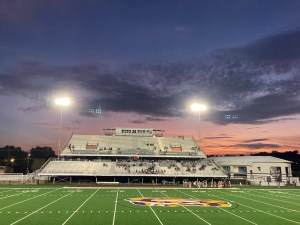
But I can’t move on from Tallassee without mentioning the Tallassee Tigers. Passing through on 14, it is impossible to miss J. E. “Hot” O’Brien Stadium, which may well be the true focal point of life here. This is a town that absolutely loves their high school football team, and that tradition is rooted in Coach O’Brien’s legacy. According to a Tallassee Tribune article from 2016:
Under Coach O’Brien, the Tallassee Tigers carried a record of 57-0-1. This would go to be one of the greatest winning streaks in the state of Alabama. In 1947 the Tigers surpassed the national record for most games without a defeat with 53 consecutive wins. During the winning streak Tallassee averaged 30 points per game and allowed only 2.7 while shutting out 39 of their 57 opponents.
For those who may interested in knowing more, there is a book: Hot and His Boys by W C. Bryant, published in 2009.
On that Saturday, though, I wasn’t thinking about high school football, just about passing or through Tallassee, over the bridge to East Tallassee, and to the east. After ambling past small homes and homesteads down a winding road, the next town of any size is Notasulga. The last estimate had nearly 900 people living there, but there must be a fair number living outside the city limits, since the community is larger enough manage to maintain a high school.
Notasulga is the birthplace of famed writer Zora Neale Hurston. Though she is typically associated with Eatonville, Florida, and though she was known to muddy the waters of her own life story, these myths and narratives don’t change facts: Hurston was born in northern Macon County in 1891 and spent her earliest years there. The novel Their Eyes Were Watching God is probably her most well-known book, but her work as a folklorist includes this place. She mentions Notasulga specifically in Jonah’s Gourd Vine.
After more winding roads, the last stop on this trip was Auburn, “the Loveliest Village on the Plains.” I was going that day to visit my daughter on her sorority’s parents day— which was also the university’s homecoming and its parents day, too. I’m not good at guessing the size of crowds, so I’ll just say that there were a shit-ton of people there that day. When I go to football games, I usually park on the side of Wire Road by the fraternity houses and walk in, since me and traffic don’t get along. Beyond that, as years go by, as more buildings are constructed, and as more traffic barriers get erected, Auburn gets harder and harder to navigate in a car, even on a normal day. Around the campus, walking is the best bet.
After a healthy jaunt in the warm sun, I found my daughter among the dozens of tailgate tents. I’ve long-ago admitted that I’m an unlikely sports dad, but I’m an even more unlikely sorority dad. Threading my way through the crowds, this was reaffirmed, and the grouchier side of me wished we could have met somewhere else. But it was her day, not mine. We got to visit, and she introduced me to a few of her friends. Unfortunately, the game that day had an 11:45 kickoff, so there wasn’t a lot of time.
The good news is that the way home was easy. I listened to the game on the radio . . . and, since almost nobody leaves Auburn at game time, I hardly encountered another car.
As with my trip down Highway 31 in south Alabama, I think about the beliefs, myths, and narratives associated with rural Alabama: backwards, ignorant, etc. Just as I noted with that stretch of highway, I’ll say again that I doubt if most Americans would drive the route that I drove that morning and think of HGTV, Indian removal, record-breaking winning streaks, or Zora Neale Hurston. If the average American even ended up out there, it would probably be to detour from a wreck in I-85, so they’d probably just wonder how long until they were back where they wanted to be. Which, ultimately, is good for me since, if they were there, I wouldn’t want to be.
 Nobody's Home