Ryan Coogler’s acclaimed period folk horror film Sinners (2025) views the violent, tempestuous history of the Jim Crow South through the lens of the supernatural. After all, what better way to examine some of the darkest manifestations of human nature than through the physical manifestations of evil: the mythic figure of the monster.
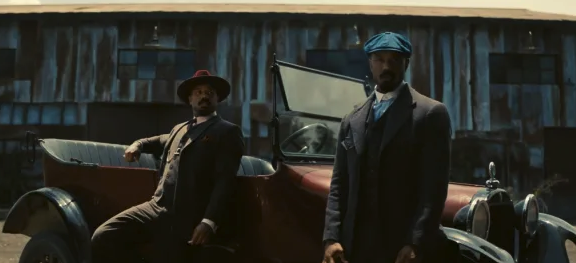
The film follows twin brothers Elijah “Smoke” Moore and Elias “Stack” Moore, former sharecroppers and notorious miscreants who return to their home in the Mississippi Delta after a stint working in Chicago’s criminal underworld. Searching for a sense of autonomy, which they have long felt denied, the brothers purchase an abandoned sawmill with the intention of opening a juke joint. They enlist the help of several old compatriots to transform the mill into the place that is, according to Stack, “for us and by us, just like we always wanted.”
The twins’ younger cousin Sammie “Preacherboy” Moore becomes central to the joint’s opening night. The son of his sharecropping plantation’s pastor, he finds himself caught between the world of faith and the world of “sin.” His music, however, is spiritual—transcendent, even. Local blues musician Delta Slim explains how the blues traveled across the sea with their ancestors. It was not forced upon them like the religion that Sammie’s father so ardently pushes on him. Sammie’s music draws a large crowd of local sharecroppers and other Black people searching for the same gatekept sense of freedom and belonging the twins are after. It also attracts a mythic force that is ancient, dark, and intent on using its spiritual power for its own benefit. As the sun sets on the juke joint, Sammie uses his talents to evoke the spirits of the past and future. A riveting scene in which the patrons of the juke joint dance alongside these spirits emphasizes the power of culture and tradition to connect and heal generations.
Enter Remmick, a mysterious white outsider who arrives at the juke joint under the guise of a search for “fellowship and love.” It is deduced by Annie, Smoke’s estranged lover and a practitioner of Hoodoo, that Remmick is, in fact, a vampire—a parasitic entity combing the region to feed not only on blood, but on vitality, culture, and spiritual power. His desire to take Sammie’s spiritual power and use it for his own purposes mirrors how historical systems have drained the Black community throughout the history of the United States, particularly in the South. Much like the Black community, though, Remmick has experienced a stripping of his own culture in the British conquest of Ireland. While claiming to only want Sammie to reconnect with his own spirituality, Remmick perpetuates the same cycle of exploitation that devoured him centuries prior.
The infiltration of the juke joint begins when Mary, a white-passing but accepted member of the local Black community and Stack’s former lover, is turned by Remmick and then turns Stack. A chain reaction of events leads to the turning of almost all the juke joint’s attendees. Only a core group of characters remains, including Smoke, Sammie, Annie, Delta Slim, local singer Pearline, and Chinese American grocer Grace Chow.
The film’s climax centers on a violent confrontation between the remaining human characters and the monstrous vampire hoard. Several of the core characters are killed in the process: Grace is consumed by fire as she kills the vampire that occupies the body of her husband Bo; Annie is bitten and killed out of mercy by Smoke; and Delta Slim sacrifices himself to the hoard so the others can escape. An emotional scene in which Smoke realizes he will have to kill his own brother emphasizes how the powers of colonialism and cultural exploitation can genuinely tear families and communities apart. Finally, Remmick is able to get his hands on Sammie. The vampire’s insatiable desire to see his own people again has led him to embrace the very evils enacted against his community. Together, Sammie and Smoke manage to overpower him, and the sunrise consumes Remmick and the hoard in a great fire. Ultimately, Remmick’s demise can be traced to his belief that he could minimize his own pain and suffering through the infliction of pain and suffering on others, perpetuating a cycle of oppression and paralleling the “lateral violence” that racial and cultural groups have often committed against one another, especially in the South.
Sammie returns to his father’s church while Smoke remains behind to destroy another threat: a hoard of Ku Klux Klan members determined to interfere with any expressions of unity and belonging displayed by the Black community. In Smoke’s heart-wrenching final scene—before his death at the hands of a Klan bullet—he sees the spirits of Annie and their infant daughter. His story ends with the viewer’s understanding that this family will now be together free from the horrors of the flawed world they lived in.
The film ends on a note both unsettling yet resilient and hopeful. Sammie, who would logically leave this “sinful” world of blues music and revelry behind, chooses to embrace his talents for what they truly are—a spiritual gift. He gets in his car and drives far from his church, his family, and his home, seemingly with no destination in mind apart from elsewhere. Scenes roll during the credits that reveal Sammie, singing in his nightclub Pearline’s, went on to have a successful career as a blues musician. A post-credits scene reveals that Stack—who Smoke just could not bring himself to kill—and Mary, have silently followed Sammie’s career across the century. Sammie admits to Stack that, despite the terrors of that night at the juke joint, he has always thought of the day leading up to it as the best one of his life, and he inquires if Stack feels the same way. Stack ends the film with a powerful statement: “No doubt about it. Last time I seen my brother. Last time I seen the sun. And just for a few hours, we was free.”
Sinners relies on the conventions of horror to examine a dark period of our history, but also to emphasize humanity’s capacity for healing through the sharing of culture and tradition. The use of vampirism as an allegory for racist and colonial systems conveys the truly blood-sucking power they possess. The emotional ambiguity of the film’s ending stems in part from the fact that no one but Sammie, Stack, and Mary remain as witnesses to the events at the juke joint. Accurate to the history of this country—and the South, in particular—atrocities occurred that have been lost to our narratives of history. However, the discovered outcome of Sammie’s life lends itself to a more optimistic view of the ending. Remmick’s seeming distance from his own past trauma allowed him to perpetuate a cycle of cultural domination, but Sinners reveals how cultural vitality can survive and retaliate against it.
reviewed by Garrett Cave
Garrett Cave is an Alabama native and Southern culture, history, and folklore enthusiast. A graduate of Auburn University, he is a writer and middle school English teacher working to instill an understanding of the complexity and an appreciation of the richness of our cultural landscape in his students every day.

