 Though it was far more crowded this year than it was when it began twenty-five years ago, the Old 280 Boogie in Waverly, Alabama still remains kind of an open secret. Started by graphic designer and screenprinter Scott Peek in the tiny community east of Auburn, the Boogie – as it is generally called – is a small-town street fair that grew into a small music festival. Peek’s company Standard Deluxe hosts the event, which is held each year in April.
Beliefs, myths, and narratives about Southern small towns tend to follow one of two tracks: the charming Mayberry where everything is quaint and everyone is friendly, or an example of the after-effects of a changing Southern economy showing blight, poverty, and lack of opportunity. Waverly, Alabama has succumbed to neither paradigm. The tiny town is about a dozen miles east of Auburn along 280; its boundaries traverse the patch of land where Lee, Chambers, and Tallapoosa counties come together. During the time I’ve been aware of it, the population has probably not exceeded 300, and being a bedroom community to a nearby college town, the locals are comprised of an eclectic mix of people.
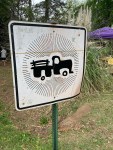
The Old 280 Boogie and Standard Deluxe more generally carry out a de facto kind of Southern-ness that is one part mythic, one part pop art, and one part quirk. Standard Deluxe’s logo is an outline of an old pickup, though the styling of the company’s artwork mixes in other unorthodox elements. One of their most infamous shirts is dark blue with blunt orange lettering that reads “COW COLLEGE,” a reference to Auburn’s roots as an agricultural institution.
My wife and I drove over on that Saturday, taking the weaving and winding two-lane roads that meander out of Tallassee to the northeast. After Reeltown, the roads twist and turn through small farms and little homesteads until Waverly appears. My wife asked me a time or two if I was sure we were on the right track, since we hadn’t taken our normal route: Highway 14 to Loachapoka then on to Waverly Road to get there. But we made it— a little car sick and a wee bit disoriented, but we got there.
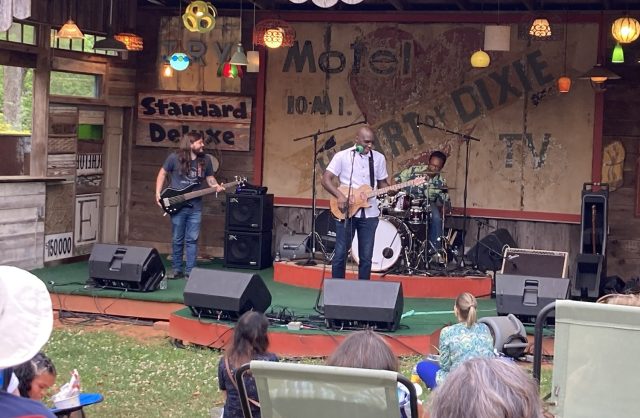
This year’s Boogie had a solid line–up. I was most interested in Cedric Burnside and Shovels & Rope. The Pine Hill Haints did a fine set, too, in the afternoon. One highlight of the trip was having a couple of “soul rolls” for dinner— pork butt, collards, cream cheese, and white beans all stuff into an egg roll and fried. Of course, Scott had the store open, offering t-shirts and posters and such. We hung out for a while with a few friends who had come as well and listened to the other Saturday acts. I was sorry we wouldn’t be able to make it back on Sunday for Cedric Burnside and Corey Harris, but it just wasn’t in the cards to make the trip twice.
In the weeks since the Boogie, on top of the buzz from the event, Country Living magazine named Waverly as one of the best small towns in the nation. I don’t know enough to make a serious judgment about that, but knowing what I do about Waverly, they’ve got a point. Having been founded nearly two-hundred years ago, there are traditional longtime residents, past generations of which occupy an old graveyard that is worth perusing for folks who are into history and all that. And, in addition to Standard Deluxe, there is also The Waverly Local, a well-known restaurant whose proprietor is one of the Wickles Pickles guys. Pound for pound, it’s a solidly interesting little place.
For us, coming to the twenty-fifth Boogie was also a quick trip down memory lane. In the first years, in the early 2000s, we found out about Waverly through my wife’s sister who had become friends with a smattering of artists, writers, etc. who lived there. That brought us to some of the first Boogies, and we returned year after year and even brought our kids when they were small. The Boogie grew and so did our family, then as I became more involved with the now-defunct Alabama Book Festival, the conflicting dates on the same weekend in April drew us in other directions. Coming back in 2026 to see how it has changed and grown reminded us what we saw more than two decades ago, a fledgling event that drew a small crowd . . . which has now grown into something greater by pursuing a new narrative of what a small Southern town can be.
 Nobody's Home