For boys growing up in the Generation-X South, there were a handful of movies that made up a mythic watchlist. Among them were the original Walking Tall from 1973, Smokey and the Bandit from 1977, and Porky’s from 1981. All set in the South, Walking Tall was infamous for its mannish violence, Smokey and the Bandit for its flagrant disrespect of law enforcement, and Porky’s for raunchy sexual comedy. Everyone had seen Smokey and the Bandit, though the uncensored Walking Tall was harder to access. But only the older boys had seen – or claimed to have seen – Porky’s, which left us younger boys to wonder at their seemingly knowledgeable insinuations punctuated by bawdy laughter.
There were three Porky’s movies in all, though only the original is a classic. The first two movies were written and directed by Bob Clark, a native of New Orleans, who lived as a boy in Birmingham, Alabama then in Fort Lauderdale, Florida— the latter was probably the inspiration for Angel Beach. The first movie in 1981 introduced us to the boys from this fictional coastal community in Florida. A 1983 sequel called Porky’s II: The Next Day attempted to ratchet up the absurdity, adding overzealous evangelicals and the Ku Klux Klan to the already established jokes. Those were followed by Porky’s Revenge in 1985, because – of course – Porky couldn’t just retreat back into the swamps and disappear. In each movie, though, the standard elements are there: a group of irreverent, fun-loving high school boys who spend their time on basketball and lewd pranks. Even though he is the smallest, weakest, and most foolish, Edward “Pee Wee” Morgan is probably the main character of these films. Other members of the group are the wily Tommy Turner, the good ol’ boy Mickey, the good-natured Billy, the tough guy Tim, the big guy Meat, and their Jewish friend Bryan. Supporting players include the school nympho Wendy Williams, the bitter gym teacher Beulah Balbricker, the sexy gym teacher Miss Honeywell, the squeamish principal Mr. Carter, a couple of half-wit coaches, and of course, the fat strip-club owner Porky.
All three Porky’s movies were set in the mid-1950s during a time of relative innocence for these white teenagers, but the nuances of Southern culture are still there. Outside of crass sexual jokes and pranks, there are features that are steeped in Southern culture. Set near the beginning of the Civil Rights movement, racial strife has not yet come to Angel Beach, so a casual Southern racism is seen in the boys’ antics and attitudes. For example, early in the first movie, the boys arrange an encounter with a white prostitute named Cherry Forever – an arrangement some of them know to be fake – which will be interrupted by a black man who is paid to act as her husband. When the angry black man bursts in with a machete, the naked and unsuspecting teenagers flee into the yard, as Tommy and Billy laugh with the man at their successful prank. The black man is bought and used, because he will be frightening in this context: outside of town where social mores won’t protect them. Furthermore, they are white boys who plan to take turns with a prostitute, who has a black husband, which really means all Southern norms and propriety have been thrown out the window!
Then, back at the drive-in that night, Tim’s father arrives and knocks him around publicly, while berating him for running away from a black man. The boys clearly don’t like it, but do nothing. The next day, when Tim comes to school with a busted face, he attempts to redeem his pride by picking a fight with Bryan, who is Jewish, calling him a “kite” (a mispronunciation of the actual slur). Unfortunately for Bryan, the boys stand silent when faced with bigotry, so Tim and Bryan fight after school. And unfortunately for Tim, Bryan beats him up, which will incite another beating from his father for losing to a Jew. After the fight, Tommy Turner and Billy walk Bryan to his car, excusing Tim’s racism and saying that’s he’s not really a bad guy. Bryan has little choice but to shrug off this antisemitism and get along with the ones who aren’t openly bigoted toward him. Later in the film, Tim and Bryan make peace, though Tim never does acknowledge that his behavior or attitudes were wrong.
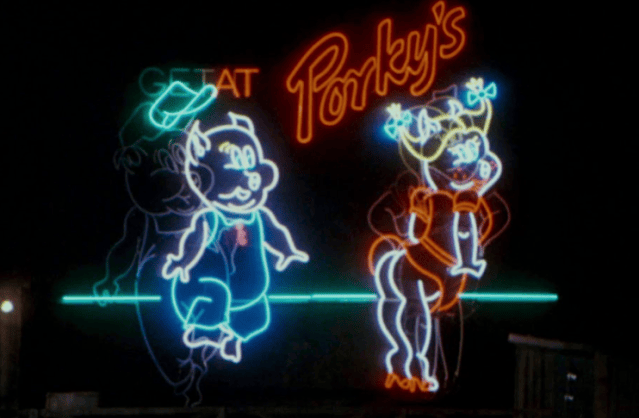
Another nuance of Southern culture utilized in the film is the relative lawlessness of people in the backwoods. Of course, Porky’s – the strip club and bar where the boys go at Mickey’s suggestion – is raucous and wild. It is down a dirt road and has a gravel parking lot. In the stage show, there are images of farming and livestock that lean toward insinuations of bestiality. Confederate flags hang prominently. Porky himself is an almost morbidly obese, middle-aged man who smokes a cigar and is urged on by throngs of rednecks around him. And when the boys from Angel Beach attempt to navigate this backwoods scene, they are tricked, laughed at, then outnumbered when they try to complain. Finally, the backwoods sheriff shows up – played by football great Alex Karras – but he is corrupt, busting up Mickey’s truck then demanding all of their money as fines. The boys are sent away, penniless and shamed, and told pointedly, This here’s a man’s county, so get your candy-asses back to Angel Beach. Every aspect of the encounter tells the viewer that you don’t go into the deep woods and mess around with these people— they’re mean, ruthless, cunning, and without conscience.
Not one to be shamed, Mickey is the one among them who seeks revenge. It was his idea to go there in the first place, and after the incident, none of the others want to go back. Mickey, however, is the redneck – that fact was established early in the movie – and he won’t be disrespected. Unfortunately for him, it is not wise to go back there, walk into Porky’s, and tell the owner that he’ll beat his “fat ass.” Mickey comes back bloodied. Unlike the other boys, who learn their lesson, Mickey is the hardcore Southerner who would rather get beat over and over than admit that someone got the best of him.
By the second movie, those dark elements take on a different tone. Bryan has become part of the group, not so much an outsider to it. The presence of everyday racism has dimmed. This time, the boys from Angel Beach have to navigate two threats at once – an overzealous preacher and the Ku Klux Klan – while still attempting to “get laid” and play basketball. The first challenge is a white-haired preacher with an overly exaggerated, constantly disapproving, Bible-waving style of social control. He is a trope, of course, one recognizable as especially Southern. His role in the story is to shut down the school play – a production of Shakespeare – because of its immoral content. In this sequel, Beulah “Ballbreaker” is converted from a grouchy PE teacher who tries to prevent people from having sex at school into a full-on evangelical nut and the preacher’s biggest cheerleader. Personally, I thought that was a mistake to alter her in this way – I would say it was a misinterpretation of her, but Bob Clark invented her – since it takes an otherwise funny character and turns her into a type.
The boys’ other challenge, perhaps added to redeem them after their acceptance of bigotry in the first movie, comes from a group of Ku Klux Klansmen. This is also a trope, one that came about in the post-Civil Rights years when the nation needed some way to cope with widespread realizations of the Klan’s menacing presence. In reality, the Klan of the 1950s, ’60s, and ’70s was organized, violent, and terrifying. This latter-day portrayal of them, which is not unique to Porky’s II, has them as inept, disorganized buffoons whose robes and hoods allow even silly teenagers to infiltrate their midst and lead them astray. Ultimately, the boys maneuver the unsuspecting Klansmen into a gymnasium full of Seminoles to answer for having beat up one of their Seminole classmates. (This act by the boys is markedly different from their inert response to antisemitism against Bryan, but it also completely absurd.) Sadly, the scene of their comeuppance isn’t funny but more odd, almost bizarre, with actions that involve kidnapping with threats of torture and mob violence. The fact that it would be the Klansmen on the receiving end doesn’t make it funny.
The final movie of the three, which Bob Clark was not involved in, has Porky to return. Though the tagline of the third movie reads, “The Pig Strikes Back,” he really doesn’t. This time, the boys’ beloved basketball coach has been betting on sports and is behind with a bookie, who is Porky. Side plots have the boys back at odds with Beulah Ballbreaker, and Meat needs to pass a science exam so he can play basketball. Porky has quietly revamped his operation on a riverboat but he is tricked into betting on the boys’ championship game in a fake agreement to throw the game. This third film doesn’t add anything new in terms of the trilogy’s Southern-ness.
Finally, what may be the most Southern thing about the whole trilogy is the imagery of Porky Wallace. Yes, Porky has a last name, and it is Wallace— like the segregationist governor George Wallace. Actor Chuck Mitchell could not have forged a better archetype for a revolting, mean, rude, redneck kingpin. This man is everything you don’t want to encounter in the backwoods of the South. His immense size, drawling accent, gruff manner of speaking, half-chewed cigar and cowboy hat, and a slow walk that is a combination of waddle and swagger . . are all threatening, which makes Porky Wallace intimidating as hell. Porky points when he talks, and he demands that you to repeat anything he doesn’t like the sound of, just to see if you will. He will take your money, convince you to pile into a closet, dump you into swamp water, then come outside to laugh at you. And what’s worse, he has a large group of friends who come out to laugh at you, too. And what’s even worse than that: his brother is the sheriff! These films may be comedies, but the character Porky is scarier than any crazed backwoods murderer-freak-sicko in any horror movie—because Porky could be real.
Most people think of Porky’s as a sex comedy, not as a movie about the South. Maybe this story could have happened somewhere, but it would have lost something if it had been. Most sex comedies fit easily under the heading of exploitation films, and this series – at least the first two films – seems to exploit something like Erskine Caldwell’s now-mythic caricatures of Southerners as lascivious buffoons, which are then carried forward into 1980s post-Civil Rights zaniness. There is a certain Tobacco Road quality to the chaos, and a set of recognizable beliefs, myths, and narratives about the South form the basis of Porky’s. Racism is unseemly but basically harmless in the hands of such idiotic people. Rednecks are generally deceptive but possibly dangerous. Religious zealots and Klansmen are there pushing extreme views but are easily outdone. And everyone – absolutely everyone! – is obsessed with sex.

